🎙️ Opening Monologue
Welcome back. The kids are asleep, the coffee is lukewarm, and tonight, we’re looking at the “Target.” If you’re like me, you probably have some old 003 study notes lying around. Well, as of 2026, those are officially “Vintage.”
HashiCorp has moved to the 004 version of the exam. Tonight, we’re breaking down the logistics, the costs, and the specific domains you need to master.
🎟️ The Box Office: Exam Logistics & Fees
- Exam Code: Terraform Associate (004) — This version focuses on Terraform 1.12+ features.
- Price: $70.50 USD, plus locally applicable taxes and fees. Note: Free retakes are not included in this price.
- Duration: 60 Minutes.
- Format: Online proctored; includes Multiple Choice, Multi-select, and True/False questions.
- Validity: 2 Years.
The “New” Stuff: 004 Differences
- Custom Validation: Know how to use
preconditionsandpostconditions. Read more here. - Moved Blocks: The clean way to refactor resources without destroying them. Reference.
- Testing Framework: The new
terraform testcommand. Reference.
🗺️ Master Index
This Master Index is a living document. Titles will be activated with hyperlinks as each blog post clears mission control and is published.
1. The IaC Monologue: Escaping ClickOps and embracing Infrastructure as Code
The “Why.” Before you write a single line of HCL, you need to understand the paradigm shift. We’re moving from the “Tourist Phase” (clicking around the portal) to the “Architect Phase” (defining reality through code). This is about why manual infrastructure is the enemy of a good night’s sleep..
- The ClickOps Trap: Defining the World Before Code
- The Great Shift: Why Manual Infrastructure Failed
- The Declaration: Defining Infrastructure as Code
- The Architect’s Edge: Core Advantages of Coding the Cloud
- Enter Terraform: Establishing a New Infrastructure Standard
- The Agnostic Power: Why Terraform Wins in Multi-Cloud Environments
- Beyond the Server: Real-World Impact at Scale
- The Comparison: Choosing the Right Tool for the Job
2. The Engine Under the Hood: Understanding Terraform Core, providers, plugins, and state
This is the “Under the Hood” segment. If you don’t understand the engine, you’re just a passenger. We’re looking at the architecture — how Terraform talks to the cloud via Translators (Providers) and how it uses its “Digital Memory” (State) to remember what it built.
- The Great Decoupling: Terraform Core and Its Translators
- The Plugin Anatomy: How Providers Speak to the World
- The Control Interface: How Terraform Is Driven
- The Versioning Tightrope: Staying Current Without Chaos
- The Project Bodyguard: The Role of the Dependency Lock File
- Operational Housekeeping: Managing Unused Providers
3. Hands on the Keyboard: Mastering the Terraform workflow: init → plan → apply → destroy
This is the “Daily Ritual.” In the Late-Night studio, this is our standard operating procedure. We move from a blank text file to a running data center using the four sacred commands: _init_, _plan_, _apply_, and _destroy_. It’s the literal choreography of a Cloud Engineer.
- The First Handshake: Initializing the Working Directory
- The Ritual of Order: Enforcing Code Formatting
- The Structural Guard: Validating Configuration Logic
- The Architect’s Preview: Understanding Planned Changes
- Precision Control: Influencing Execution with Inputs and Flags
- The Moment of Truth: Applying Changes to Reality
- The Clean Slate: Destroying Managed Infrastructure
- Distributed Trust: Running the Workflow Across Environments
4. The Grammar of Infrastructure: Learning HCL syntax, structure, and configuration patterns
Our “Feature Length” segment. You can’t write a screenplay if you don’t know the language. We’re diving into HashiCorp Configuration Language (HCL) — the blocks, the arguments, and the syntax that turns your intentions into actual cloud resources.
- The Building Blocks: Distinguishing Blocks from Arguments
- Signatures and Notes: Identifiers, Labels, and Comments
- The Blueprint Layout: Organizing Files and Configuration Structure
- The Final Word: Understanding Overrides and Precedence
- Beyond Deployment: Specialized Configuration Files and Use Cases
5. The Four Pillars: Understanding terraform, provider, resource, and data blocks
Every Terraform file stands on these four legs. We’ll learn to distinguish between the “Nouns” (Resources), the “Gateways” (Providers), and the “Reading Lens” (Data Sources). Master these, and you can build anything.
- The Anchor: Establishing Global Settings with the Terraform Block
- The Gateway: Negotiating Access with the Provider Block
- The Nouns of Infrastructure: Defining Reality with Resource Blocks
- The Reading Lens: Querying Existing Infrastructure with Data Sources
- The Language of Links: Understanding References and Named Values
6. Escaping Hard-Coded Walls: Using variables, locals, and outputs to build flexible infrastructure
This is about “Flexibility.” If you hard-code your IP addresses, you’re building a statue, not a system. We’ll use Variables to create “Dials” for our infrastructure, making it reusable across Dev, Test, and Prod without changing a single line of core code.
- The External Dials: Customizing Environments with Input Variables
- The Assignment Hierarchy: Understanding Variable Precedence
- The Internal Workbench: Reducing Noise with Local Values
- The Code Loudspeaker: Exposing Results with Output Values
- The Data Guardrails: Enforcing Integrity with Type Constraints
7. The Logic Gate: Applying expressions, functions, conditionals, and iteration
The “Intelligence” segment. Why build one server when you can build ten with a single loop? We’re looking at the math and logic that allows Terraform to make decisions, transform data, and handle complex collections like a pro.
- The Textual Fabric: Manipulating Strings and Templates
- The Arithmetic of Cloud: Using Operators and Conditional Expressions
- The Built-in Toolkit: Leveraging Terraform Functions
- The Efficiency Engines: Transforming Collections with
[for](https://medium.com/@isbhuvan/late-night-terraform-the-logic-gate-0dd2b581a692#914b)and[splat](https://medium.com/@isbhuvan/late-night-terraform-the-logic-gate-0dd2b581a692#914b)Expressions - Architectural Origami: Scaling Configuration with Dynamic Blocks
- The Sandbox: Experimenting with Logic Using
[terraform console](https://medium.com/@isbhuvan/late-night-terraform-the-logic-gate-0dd2b581a692#2efc)
8. The Safety Net: Enforcing lifecycle rules and custom validations
This is the “Housekeeping” segment. It’s one thing to build a house; it’s another to keep the roof from leaking. We’ll look at how to protect critical resources from accidental deletion and how to tell Terraform: “Don’t you dare apply this if the input looks wrong.”
- The Code of Conduct: Governing Behavior with the Lifecycle Block
- The Irreversible Line: Controlling Resource Replacement and Destruction
- The Blind Spot: Managing Unmanaged Changes with ignore*changes
- The Reactive Chain: Triggering Replacement with replace_triggered_by
- The First Filter: Enforcing Input Integrity with Variable Validation
- The Logical Gates: Enforcing Truth with Preconditions and Postconditions
- The Continuous Watch: Monitoring Assumptions with Check Blocks
- The Hierarchy of Trust: Understanding Validation and Enforcement Order
9. The Vault Door: Managing secrets and sensitive data securely
The “High Stakes” segment. Putting passwords in plain text is a 2:00 AM phone call you don’t want. We explore how to handle sensitive values, where the “ghosts” live in your state file, and how to keep your secrets away from prying eyes.
- The Exposure Risk: Why Secrets Demand Special Handling
- The Layered Defense: Strategies for Managing Sensitive Values
- The Root of Trust: Authenticating Providers Without Hardcoding Secrets
- The Ghost in the Machine: How Sensitive Data Lives in State
10. The Assembly Line: Designing reusable infrastructure with modules
The “Efficiency” segment. If you find yourself copy-pasting code, you’ve already lost. Modules are how we package infrastructure into neat, reusable boxes that the rest of the team can use safely and consistently.
- The Blueprint Revolution: Why Modules are the Unit of Scale
- The Interface: Understanding the
[module](https://medium.com/@isbhuvan/late-night-terraform-the-assembly-line-00a87b3fb28d#f181)Block - The Global Warehouse: Sourcing Code from Local Paths to the Registry
- The Standard Pattern: Structuring Professional Terraform Modules
- Nested Architecture: Composing Infrastructure with Child Modules
- The Hand-off: Managing Provider Inheritance Across Modules
11. The Source of Truth: Managing state, backends, locking, and drift
This is the most critical domain. If you mess up your state, you’re in for a very long night of manual recovery. We look at how Terraform “remembers” reality, how to lock it so colleagues don’t overwrite you, and how to fix “Drift” when reality changes behind your back.
- The Digital Mirror: Why State Is the Heart of the Machine
- The Sacred Text: Why State Is Treated as Read-Only
- The Shared Memory: Collaboration and Security with Remote Backends
- Parallel Realities: Isolating Environments with Terraform Workspaces
- The Break-Glass Protocol: When and How to Intervene in State
- Surgical Removal: Safely Removing Resources from State
- The Watchtower: Inspecting and Auditing Terraform State
12. Adopting the Past: Importing existing infrastructure into Terraform
The “Archaeology” segment. We don’t always get to start with a green field. Sometimes we have to go into the portal, find what was built by hand years ago, and bring it under the disciplined umbrella of Terraform control.
- The Archaeology of Cloud: Why Bringing Legacy Resources Under Control Matters
- The Controlled Ingress: Understanding the terraform import Workflow
- The Reality Check: Limitations and Risks of Importing Resources
- The Forensic Lens: Troubleshooting Import and State Alignment Issues
13. Mission Control: Scaling collaboration with HCP Terraform
The “Big League” segment. In a real org, you don’t run Terraform from your laptop while sitting on the couch. You use a managed platform. We’ll look at Workspaces, OIDC, and the governance features that make professional collaboration possible.
- Mission Control: The Foundations of HCP Terraform
- The Control Rooms: Workspaces as Operational Units
- The Invisible Hand: Remote Operations Behind the Scenes
- Docking the CLI: Integrating Local Tools with the Cloud
- Launch Sequences: Runs, Plans, and Applies
- The Vault: State, Variables, and Secrets
- The Invisible Key: Dynamic Provider Credentials with OIDC
- The Watchtower: Governance, Visibility, and Guardrails
🧠 The Overthinker’s Manifest
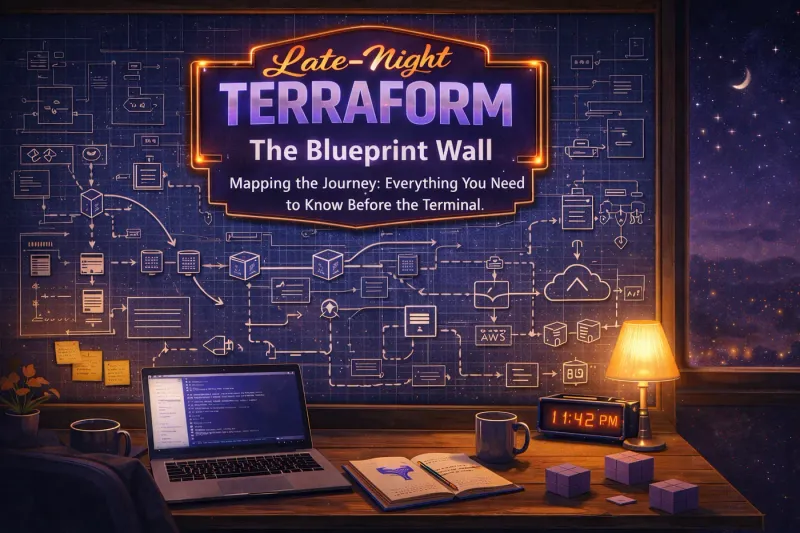
Looking at the Master Index above might feel like staring at a mountain of HCL. Your brain might be saying, “Do I really need to memorize all of this tonight?”
The short answer: No. I’ll be honest — I’m a professional overthinker. If there’s a “what if” scenario in a Terraform deployment, I’ve probably lost sleep over it. I’m utilizing that overthinking as my secret weapon for this preparation.

I created this specific post as my “Cheat Day.” Today’s Goal: Zero coding. Zero labs.
- The Mission: Just listing the targets. I am defining the boundary of what I need to learn — no more, and certainly no less.
Everything else? We’ll pull that from the “thin air” of our 10 years of experience and the scars we’ve earned in the trenches. Think of this list not as a “To-Do” list, but as a “Boundary Map.” We are going to tackle them one by one, slowly, when the house is quiet.
🎬What’s Next
That’s the roadmap. It’s a lot, but we’re going to tackle it one segment at a time. In the next episode, we start at the beginning: Domain 1 We’ll look at why we use IaC and why Terraform.
I’m Bhuvan. It’s 1:30 AM. Go to bed, you’ve done enough for one night!